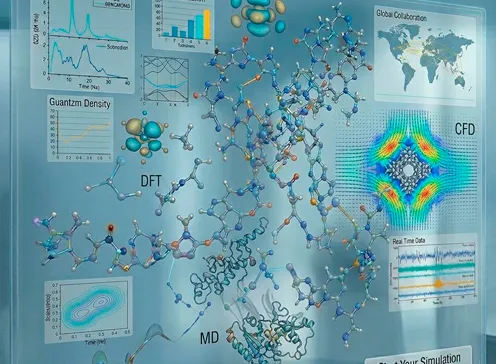
Choosing between DFT and molecular dynamics can be confusing. The wrong method may waste computing resources or fail to answer the scientific question you actually care about.
Density Functional Theory (DFT) calculates electronic structure using quantum mechanics, while Molecular Dynamics (MD) simulates how atoms or molecules move over time. DFT offers detailed electronic-level insight; classical MD enables larger systems and longer timescales.
Both methods are widely used in computational materials science, chemistry, and physics. Understanding what each method calculates—and where its limitations lie—helps researchers design more efficient simulation workflows.
Need electronic properties, bonding mechanisms, or reaction energetics? Classical models may not provide the quantum-level information required to explain these phenomena.
DFT is a quantum-mechanical method used to calculate the electronic structure and related properties of atoms, molecules, and materials, including energies, charge distributions, electronic states, and optimized structures.
DFT treats electronic behavior explicitly through electron density, making it particularly useful when a research problem depends on bonding or electronic properties.
Common applications include:
Electronic band structures
Density of states
Adsorption energies
Defect formation energies
Structural optimization
Reaction energetics
Magnetic properties
Software packages such as Quantum ESPRESSO provide tools for electronic-structure calculations based on DFT.
DFT can provide detailed atomic- and electronic-level information, but its computational cost increases substantially as the number of atoms grows. As a result, routine DFT calculations generally involve smaller systems than classical molecular dynamics simulations.
Knowing the stable structure of a material is not always enough. Researchers may need to understand how atoms move, diffuse, deform, or reorganize under changing conditions.
Molecular Dynamics simulates the time-dependent motion of atoms by numerically integrating equations of motion. Classical MD usually describes atomic interactions using predefined force fields or interatomic potentials rather than calculating electronic structure at every step.
Molecular dynamics is especially useful for investigating dynamic and statistical behavior, including:
Atomic diffusion
Thermal behavior
Mechanical deformation
Polymer dynamics
Interfaces
Structural evolution
Phase-related processes
LAMMPS is a widely used molecular dynamics software package designed for atomistic and materials simulations.
Because classical MD simplifies electronic interactions through force fields, researchers can generally simulate much larger systems and longer timescales than with conventional DFT.
Both methods investigate matter at the atomic scale, but they answer different scientific questions. Treating them as interchangeable may lead to unnecessary computation or unsuitable results.
The main difference is that DFT focuses on quantum-mechanical electronic structure, whereas classical MD focuses on atomic motion using predefined interaction models. DFT prioritizes electronic-level information, while MD provides access to larger systems and longer simulation times.
| Factor | DFT | Classical MD |
|---|---|---|
| Main focus | Electronic structure | Atomic motion |
| Physical model | Quantum mechanics | Classical mechanics |
| Atomic interactions | Electronic calculations | Force fields or potentials |
| Typical system size | Smaller | Larger |
| Accessible timescale | Shorter | Longer |
| Best suited for | Electronic and energetic properties | Dynamic and structural behavior |
| Computational cost per atom | Higher | Lower |
The distinction is not always absolute. Ab initio molecular dynamics (AIMD) combines electronic-structure calculations with molecular dynamics.
Instead of relying entirely on predefined classical force fields, AIMD calculates atomic forces from electronic-structure methods such as DFT during the simulation.
This provides more detailed information about chemical bonding and reactions, but the computational cost usually limits the accessible system size and simulation time.
Using the most computationally sophisticated method is not always the best strategy. The correct choice depends on the physical phenomenon, system size, timescale, and output required.
Choose DFT when your research question depends on electrons, chemical bonding, or quantum-level energetics. Choose classical MD when you need atomic trajectories, larger systems, or longer-timescale behavior. Some research problems benefit from combining both approaches.
Choose DFT when investigating questions such as:
Is a structure energetically stable?
How does adsorption occur?
What is the electronic band structure?
How does a defect influence electronic properties?
What are the energetics of a chemical reaction?
Choose MD when investigating:
How do atoms or molecules diffuse?
How does a material deform under stress?
How does temperature influence atomic structure?
How does an interface evolve over time?
How do polymers or other large molecular systems behave dynamically?
For multiscale research, DFT calculations can also provide reference data for developing or validating interatomic potentials used in larger MD simulations.
The simulation workflow should therefore begin with the research question, rather than simply choosing a familiar software package.
DFT reveals electronic-level properties, while MD tracks atomic motion across larger systems and longer timescales. The right method depends on the scientific question, scale, accuracy, and available computing resources.
Not necessarily. DFT and MD address different physical problems. DFT provides quantum-mechanical electronic information, while classical MD focuses on atomic dynamics. Accuracy depends on the method, parameters, and research question.
Yes. Researchers can use DFT to generate or validate atomic-level data and then apply MD to investigate larger systems or longer-timescale behavior.
Ab initio molecular dynamics calculates atomic trajectories while obtaining forces from electronic-structure calculations, commonly DFT, rather than relying entirely on predefined classical force fields.
For comparable system sizes and simulation steps, DFT is generally much more computationally intensive because electronic structure must be calculated. Classical MD can therefore handle substantially larger atom counts.
Neither method is universally better. DFT is suited to electronic structure, bonding, and energetics, while MD is better suited to diffusion, deformation, thermal behavior, and dynamic processes in larger systems.